How Airbnb Turned Rejection Into a $100+ Billion Company

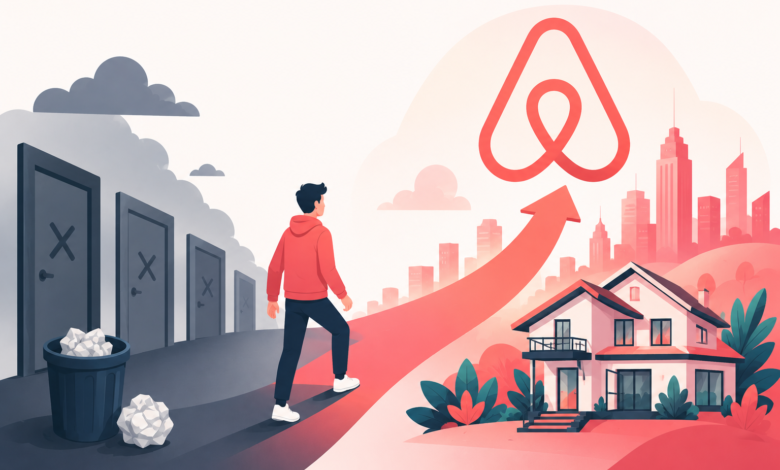
What if 100 investors rejected your startup?
Most founders believe one rejection means they’re doing something wrong.
Ten rejections feel discouraging.
Twenty make them question the business.
Now imagine hearing “no” more than a hundred times.
That’s exactly what happened to Airbnb.
Today, it’s one of the world’s largest travel platforms, serving millions of guests across nearly every country. But long before it became a household name, Airbnb looked like an idea that many investors couldn’t understand. The founders weren’t building another hotel chain or travel agency. They were asking strangers to sleep in other strangers’ homes—a concept that sounded risky, unfamiliar, and almost impossible to scale.
Looking back today, it’s easy to assume Airbnb’s success was inevitable. It wasn’t. Like most successful startups, its journey was filled with uncertainty, financial struggles, and moments when giving up would have seemed like the logical decision.
The Problem Was Never the Idea
When Airbnb launched in 2008, the world was already full of hotels. Investors questioned whether anyone would trust a platform built around staying in someone else’s spare room. Safety concerns dominated nearly every conversation. Even the founders admitted that convincing people to embrace the concept was one of their biggest challenges.
But instead of changing the vision every time someone doubted them, they focused on understanding the people who were willing to try it.
Rather than chasing rapid expansion, they spent time speaking directly with hosts, improving listings, and learning why people booked—or why they didn’t. Those conversations revealed something that spreadsheets couldn’t. The product wasn’t failing because the idea was weak. It was failing because the experience wasn’t yet good enough.
That distinction changed everything.
Customer Experience Became Their Growth Strategy
One of Airbnb’s earliest decisions has become legendary in startup circles. The founders personally visited hosts, photographed properties with professional cameras, and helped improve listings. It wasn’t glamorous work, and it certainly wasn’t scalable.
Yet it solved the biggest problem the platform faced.
Better photographs increased trust. More trust led to more bookings. More bookings encouraged additional hosts to join the platform, creating the network effect that investors eventually celebrated.
Many startups would have tried to solve the problem with marketing.
Airbnb solved it by improving the product itself.
That lesson remains just as relevant today.
Growth becomes much easier when customers genuinely enjoy the experience.
Funding Didn’t Create Airbnb’s Success
It’s tempting to believe Airbnb became successful because investors eventually believed in the company.
The timeline tells a different story.
Investors became interested only after the founders had already demonstrated resilience, customer demand, and consistent improvement. The funding accelerated a business that was already moving in the right direction.
That’s an important distinction.
Capital helped Airbnb expand internationally, hire exceptional talent, and improve its technology. But none of those advantages would have mattered if people hadn’t already found value in the platform.
Money amplified momentum.
It didn’t create it.
What Founders Can Learn
Every startup faces rejection. Some hear it from customers. Others hear it from investors. The companies that survive aren’t always the ones with the best ideas. They’re often the ones that learn the fastest.
Airbnb reminds us that rejection isn’t necessarily evidence of a bad business. Sometimes it’s evidence that the market hasn’t fully understood your vision yet. Sometimes it simply means your product still needs refinement.
Instead of treating rejection as failure, founders should treat it as feedback. Every conversation with a customer, every investor meeting, and every unsuccessful launch provides information that can strengthen the business—if the team is willing to listen.
What Foxhog Ventures Believes
At Foxhog Ventures, we often meet founders who become discouraged after a handful of investor rejections. It’s understandable. Building a startup requires conviction, and repeated “no’s” can shake even the strongest founders.
But history shows that investor rejection is rarely the final verdict on a business.
Companies like Airbnb succeeded because they focused less on changing investor opinions and more on improving customer experiences. As their business became stronger, investor confidence naturally followed.
That’s why we believe founders should spend less time asking, “Why didn’t investors invest?” and more time asking, “What can we improve before the next conversation?”
The answer to that question often determines the future of the company.
Final Thoughts
Airbnb’s story isn’t really about fundraising.
It’s about resilience.
It’s about understanding customers better than competitors.
And it’s about refusing to let rejection define the future of the business.
Every founder will hear “no.”
The companies that ultimately change industries are usually the ones that keep building long after everyone else has stopped believing.
At Foxhog Ventures, we believe funding is important but conviction, execution, and customer trust will always matter more. Investors may write the cheque, but it’s customers who determine whether a company deserves to exist.