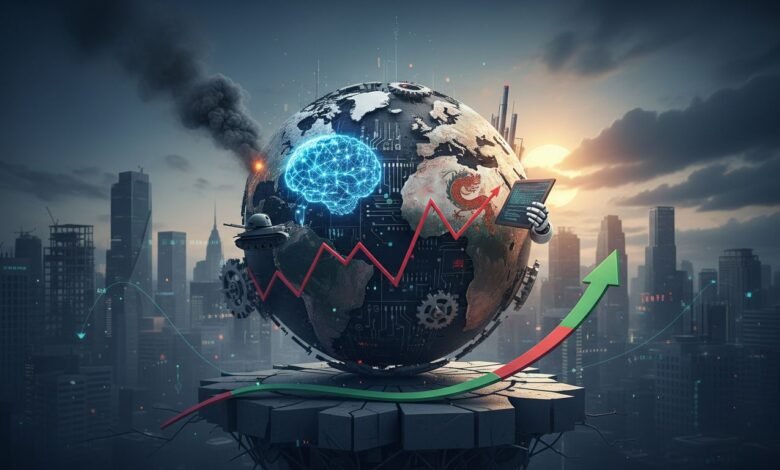
Growth expectations for the world economy are being rewritten by three forces that would have seemed difficult to combine in a single narrative just a few years ago: war-driven supply shocks, the rise of artificial intelligence, and China’s structural deceleration. Together, they are changing not only line forecasts, but also the geography of opportunity, the balance of risks, and the assumptions policymakers and investors use to think about the years a.
Recent assessments from the IMF and the World Bank point in the same direction. Global growth is slowing, the outlook is more uneven, and upside potential is increasingly tied to a country’s ability to benefit from AI while withstanding geopolitical and trade-related disruptions. In that context, understanding how war, AI and China’s slowdown are reshaping growth expectations has become essential for interpreting the global economic outlook.
A Lower Global Growth Baseline for 2026
The broad starting point is simple: the global economy is losing momentum. The World Bank said in its June 2026 Global Economic Prospects that global growth is expected to slow further in 2026, with the conflict in the Middle East helping push world growth to its lowest rate since the onset of COVID-19. It also noted that forecasts for two-thirds of economies were downgraded relative to January, underscoring how widespread the deterioration has become.
The IMF’s July 2026 update offered a slightly different numerical profile but a similar message on fragility. It projected global growth at 3.0% in 2026 and 3.4% in 2027, describing the outlook as uneven rather than uniformly weak. That nuance matters: the world is not collapsing into a synchronized recession, but it is moving into a period where growth is slower, more segmented, and more vulnerable to shocks.
This matters because lower baseline growth changes everything else. When the trend rate of expansion is modest, any disruption in energy, trade, finance, or confidence has a larger effect on incomes, investment, and fiscal stability. The World Bank also warned of a prolonged and broad-based slowdown in potential growth, suggesting that the issue is not only cyclical weakness in 2026 but a deeper erosion of the world economy’s capacity to grow rapidly later in the decade.
War as a Direct Shock to Output and Confidence
One of the clearest reasons for weaker growth expectations is war. The IMF said in July 2026 that the global economy is being pulled by two opposing major forces, beginning with a negative supply shock from war. That phrase captures the macroeconomic significance of conflict: war does not merely damage one region, it disturbs production, transport, pricing, and expectations across many economies.
The transmission channels are well understood but newly powerful. According to IMF briefings, war is feeding growth downgrades through higher energy prices, tighter financial conditions, and uncertainty, all of which weigh on private spending and soften regional growth prospects. The World Bank made a similar point, saying the Middle East conflict is expected to slow global growth through higher energy prices, steeper inflation, and increased borrowing costs.
The result is a drag that reaches far beyond the immediate combat zone. Energy importers face larger bills, inflation-prone economies are forced into tighter policy settings, and poorer countries see financing conditions deteriorate just as they need investment the most. This is one reason the World Bank also warned that developing economies are facing the weakest per-capita income growth since the pandemic, highlighting how geopolitical conflict can intensify already fragile development paths.
AI as a New Source of Growth Optimism
Against that darker backdrop, artificial intelligence is emerging as the main source of upside in global growth expectations. The IMF’s July 2026 update said that while war is clouding the outlook, AI is lifting parts of the global technology value chain. That is an important shift in the economic conversation: AI is no longer treated only as a long-run productivity idea, but also as a current driver of demand, investment, and sectoral momentum.
The World Bank’s June 2026 report reinforced this view, arguing that AI could become a catalyst for faster productivity growth. In a world facing a prolonged slowdown in potential growth, that possibility carries major weight. If firms can use AI to automate tasks, improve logistics, speed up research, and raise capital efficiency, then some of the structural weakness weighing on advanced and emerging economies could be offset over time.
There is also a development dimension. The World Bank’s August 2026 AI report said AI could allow developing countries to do in a decade what might otherwise take a century, provided they close gaps in electricity, connectivity, skills, and institutions. That makes AI more than a narrow technology story. It becomes a force that can alter national growth trajectories, shape investment priorities, and redefine which economies outperform in the next phase of globalization.
Why AI Will Not Lift All Economies Equally
For all the enthusiasm, the benefits of AI are far from automatic. Both the IMF and the World Bank emphasize that AI’s impact remains highly uncertain and unevenly distributed. Countries without the right physical, digital, and institutional foundations risk being left behind, even if AI transforms output in economies that already have strong infrastructure and skilled labor.
The IMF has been explicit about the conditions required for AI and digitalization to support growth. These include investment in skills, energy systems, digital infrastructure, governance, and cybersecurity. In practical terms, that means AI may raise growth expectations in economies integrated into the technology value chain, while doing much less in places where power shortages, weak connectivity, limited human capital, or poor institutions constrain adoption.
This is why a big macro theme in 2026 is not simply that AI is boosting growth, but that AI is redistributing growth. It is already lifting demand in specific sectors and countries, especially those linked to semiconductors, data infrastructure, software, and high-tech manufacturing. Yet the same trend can widen gaps between leaders and laggards, making the global outlook more uneven even when aggregate growth benefits slightly.
China’s Slowdown Looks Increasingly Structural
The third major force reshaping growth expectations is China’s slowdown. What stands out in 2026 is that major institutions are increasingly treating weaker Chinese growth not as a short cyclical interruption, but as a structural downshift. The World Bank’s June 2026 Global Economic Prospects said China’s growth is expected to slow to 4.4% in 2026, while the IMF’s July 2026 update projected 4.6%, both pointing to weaker momentum and deeper winds.
Other forecasts underline the same pattern. The World Bank’s April 2026 East Asia and Pacific update projected China’s growth decelerating from 5.0% in 2025 to 4.2% in 2026 and 4.3% in 2027, citing weak domestic demand, property-sector challenges, and slower export growth. Its January 2026 Global Economic Prospects similarly expected growth to decline to 4.4% in 2026 and 4.2% in 2027 because of subdued demand amid an ongoing structural slowdown.
The IMF’s April 2026 outlook extended the story further, saying China’s 2027 growth could slow to 4.0% as structural winds build. It specifically cited a grinding housing slowdown, a declining labor force, lower returns on investment, and slower productivity growth. Those are not temporary obstacles. They suggest that one of the world’s main engines of expansion is moving into a lower-growth era with important implications for trade, commodity demand, manufacturing, and confidence across the global economy.
China’s Weakness Matters Far Beyond China
China’s slower expansion matters because it affects nearly every region through multiple channels. A softer Chinese economy can mean weaker import demand, reduced support for commodity exporters, less momentum in regional supply chains, and lower confidence among multinational firms exposed to Chinese consumers. When the world’s second-largest economy grows more slowly on a sustained basis, global growth expectations inevitably adjust downward.
That is one reason the interaction between China’s slowdown and the wider global weakness is so important. The World Bank has described the broader world economy as experiencing a prolonged and broad-based slowdown in potential growth. If China is no longer able to deliver the kind of demand impulse it once did, then other economies cannot assume that Chinese expansion will compensate for weakness elsewhere.
At the same time, China is not simply stalling. The World Bank noted that resilience in early 2026 came from high-tech investment and exports, even as the broader slowdown persisted. This means China still matters as a source of industrial demand and technological competition, but its contribution is becoming narrower and less powerful than in previous decades.
The Emerging Upside Case for China and the World
Despite the structural concerns, there remains an upside case centered on policy support and technology. The World Bank said China’s growth could exceed projections if fiscal stimulus and AI-related investments prove stronger than expected. That possibility is significant because it suggests China’s future path may depend increasingly on whether it can use targeted support and technological upgrading to offset weakness in property and domestic demand.
This potential link between China and AI is also globally relevant. If China accelerates investment in advanced manufacturing, digital infrastructure, and AI-enabled production, it could stabilize parts of global supply chains and create new pockets of demand. Yet such gains would not fully erase the structural drags identified by the IMF, especially demographic pressure and lower returns on traditional investment.
More broadly, the upside scenario for the world economy now looks narrower and more conditional than before. AI can help, China can partially cushion weakness through high-tech momentum and stimulus, and some economies may benefit from being embedded in the technology chain. But those positives exist alongside a fragile geopolitical environment and a lower global growth base, which means upside surprises are possible without restoring the stronger growth expectations that once seemed normal.
A More Uneven and Fragile Global Outlook
The most important takeaway from 2026 is that growth expectations are no longer shaped by a single dominant macro force. Instead, the outlook reflects a three-way interaction between war-driven shocks, AI-driven upside, and China’s structural slowdown. The IMF’s April 2026 outlook made this explicit by warning that a prolonged conflict, deeper geopolitical fragmentation, disappointment over AI-driven productivity, or renewed trade tensions could weaken growth and unsettle markets.
Trade tensions and policy uncertainty further complicate the picture. The World Bank’s January 2026 outlook said global growth is forecast to edge down in 2026 partly because of rising trade barriers and elevated uncertainty. That means even if direct war damage is contained and AI investment remains strong, policy choices can still interfere with capital spending, cross-border trade, and long-term planning.
The resulting global pattern is slower, more uneven, and more fragile than earlier forecasts implied. Some countries will gain from AI-linked demand, some will suffer disproportionately from energy and financing shocks, and many will face both opportunities and constraints at the same time. In that environment, line growth numbers tell only part of the story; the deeper change is in how unevenly growth is being distributed across sectors, regions, and income levels.
Looking a, the central question is no longer whether the world economy can grow, but what kind of growth it can sustain under intensifying geopolitical and structural pressures. The IMF’s forecast of 3.0% global growth in 2026 and 3.4% in 2027 suggests that expansion continues, but without the breadth or resilience that would make the outlook feel secure. War remains a drag, AI remains a selective boost, and China remains a source of both support and concern.
That is why the debate over growth expectations has changed so fundamentally. How war, AI and China’s slowdown are reshaping growth expectations is not just a theme for economists; it is now the framework through which governments, businesses, and investors must assess risk and opportunity. The world economy is still moving forward, but in a way that is increasingly fragmented, conditional, and dependent on which countries can adapt fastest to this new landscape.